
Find the most frequently asked questions from our customers about Vit'i5 range: the new products in the range, their composition, their use and their acceptance by your animal.
Vit'i5 range
Introduction
Vit'i5 range of mineral and vitamin supplements has evolved to better meet the needs of carnivores (dogs, cats, ferrets) who are fed a only or partly with a homemade diet.
Vit'i5 Ration Ménagère (orange)
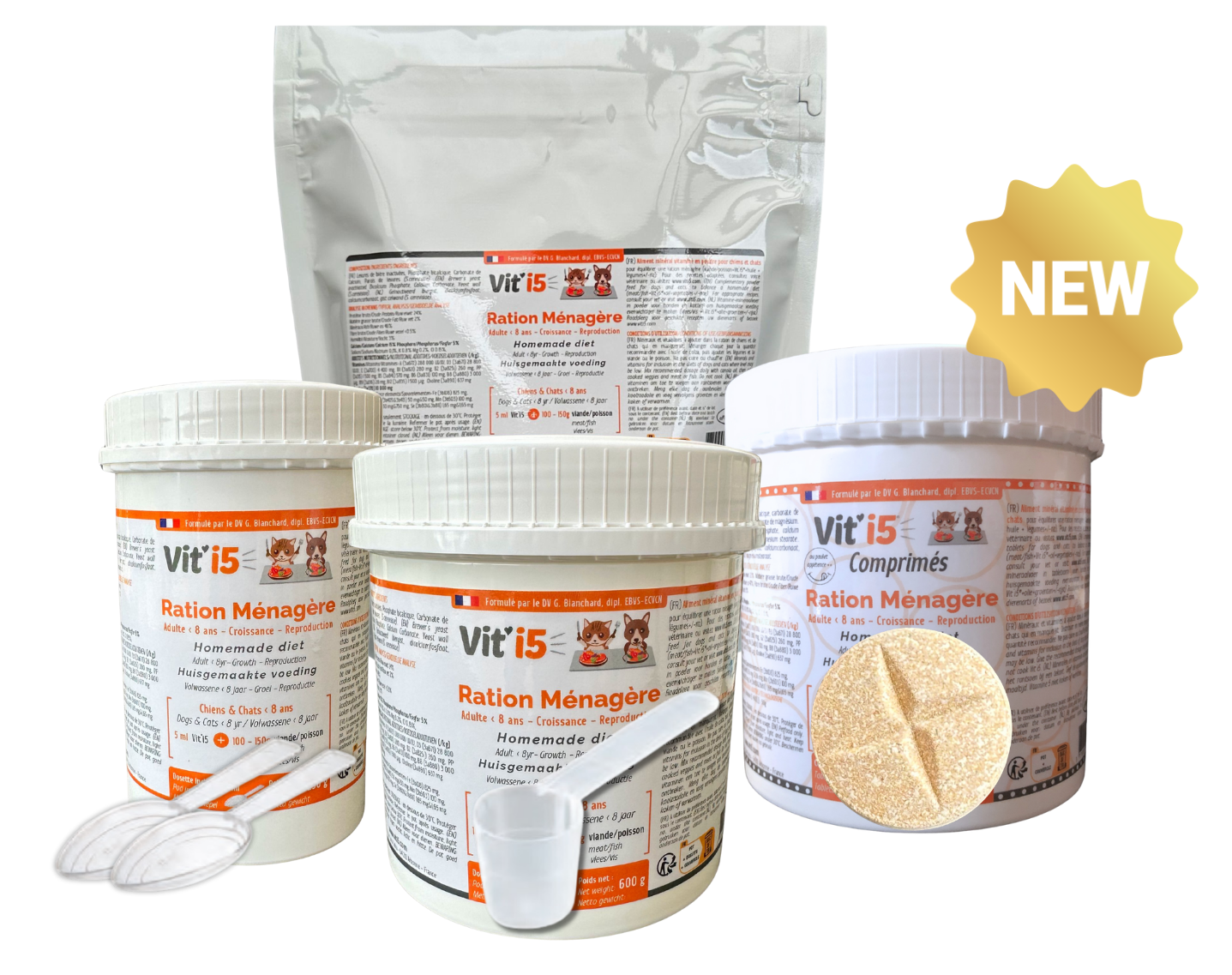 |
Vit’i5 Ration Ménagère(available in powder: 250g and 600g or in refill or in tablets )for cats and dogs exclusively fed a homemade diet > for puppies and kittens Indicative adult dose : 1 scoop of 5 ml for 100 to 150g of muscle meat or fish filet |
Vit'i5 Senior Ration Ménagère (bleu)
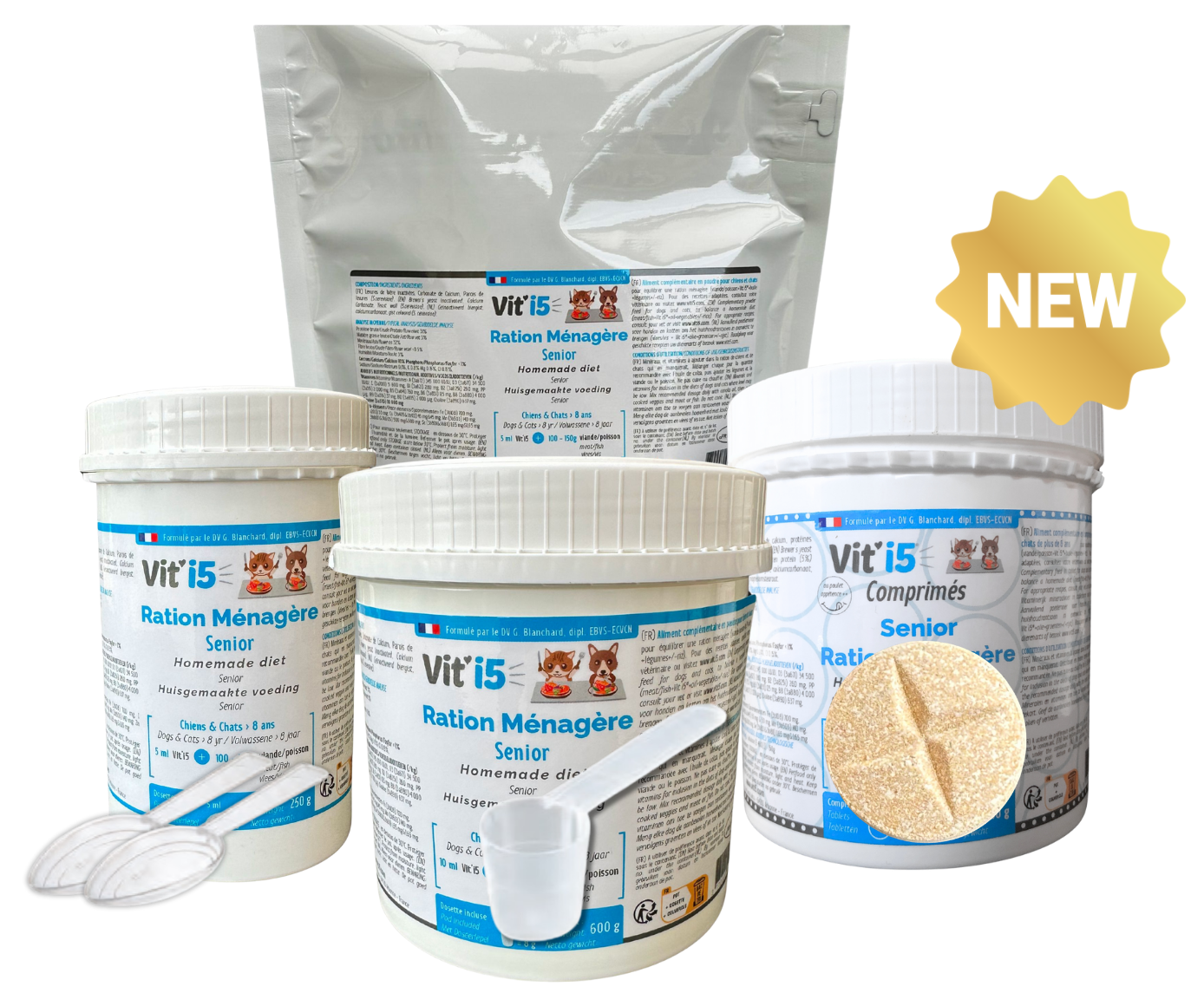 |
Vit’i5 Senior Ration Ménagère(available in 250g and 600g , refill and tablets )without PHOSPHORUS > healthy dogs/cats over 8 yr-old and at any age when restriction in phosphorus and minerals is required (urolithiasis, renal failure) Indicative adult dose : 1 scoop of 5 ml for 100-150g of muscle meat or fish filet |
Vit'i5 Ration Mixte (rouge)
 |
Vit’i5 Ration Mixte
(available in 250g and 600g , refill and tablets)
Kibble in the morning and homemade diet in the evening ?
|
Vit'i5 Uro Ration ménagère (jaune)
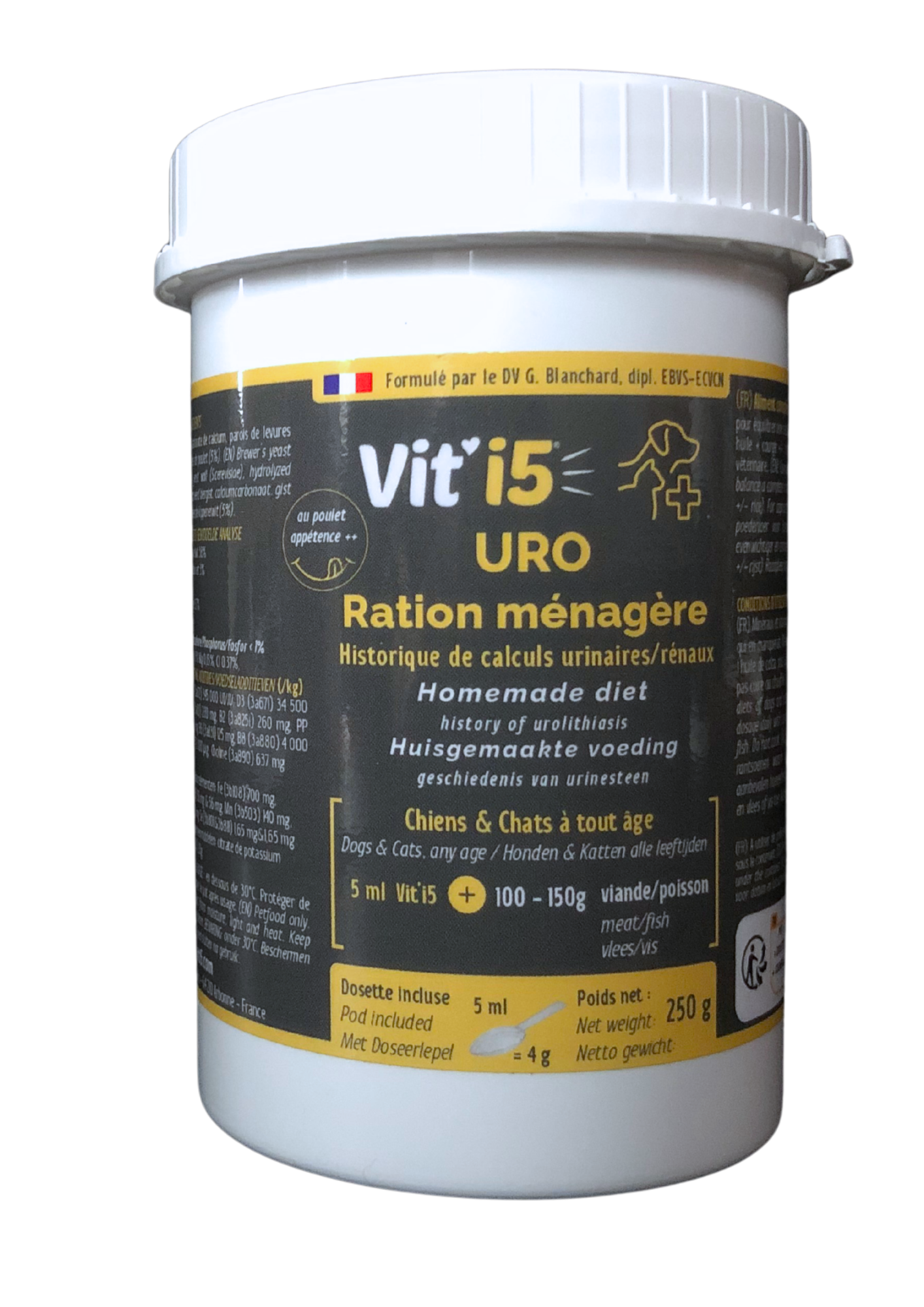 |
Vit’i5 Uro ration ménagèreAvailable in powder : 250gMineral & vitamin powder feed for dogs and cats to balance a homemade diet (meat or fish + Vit’i5®™ + oil + vegetables +/- rice)for dogs and Cats with history of urolithiasis
|
Vit'i5 Renal Ration ménagère (turquoise)
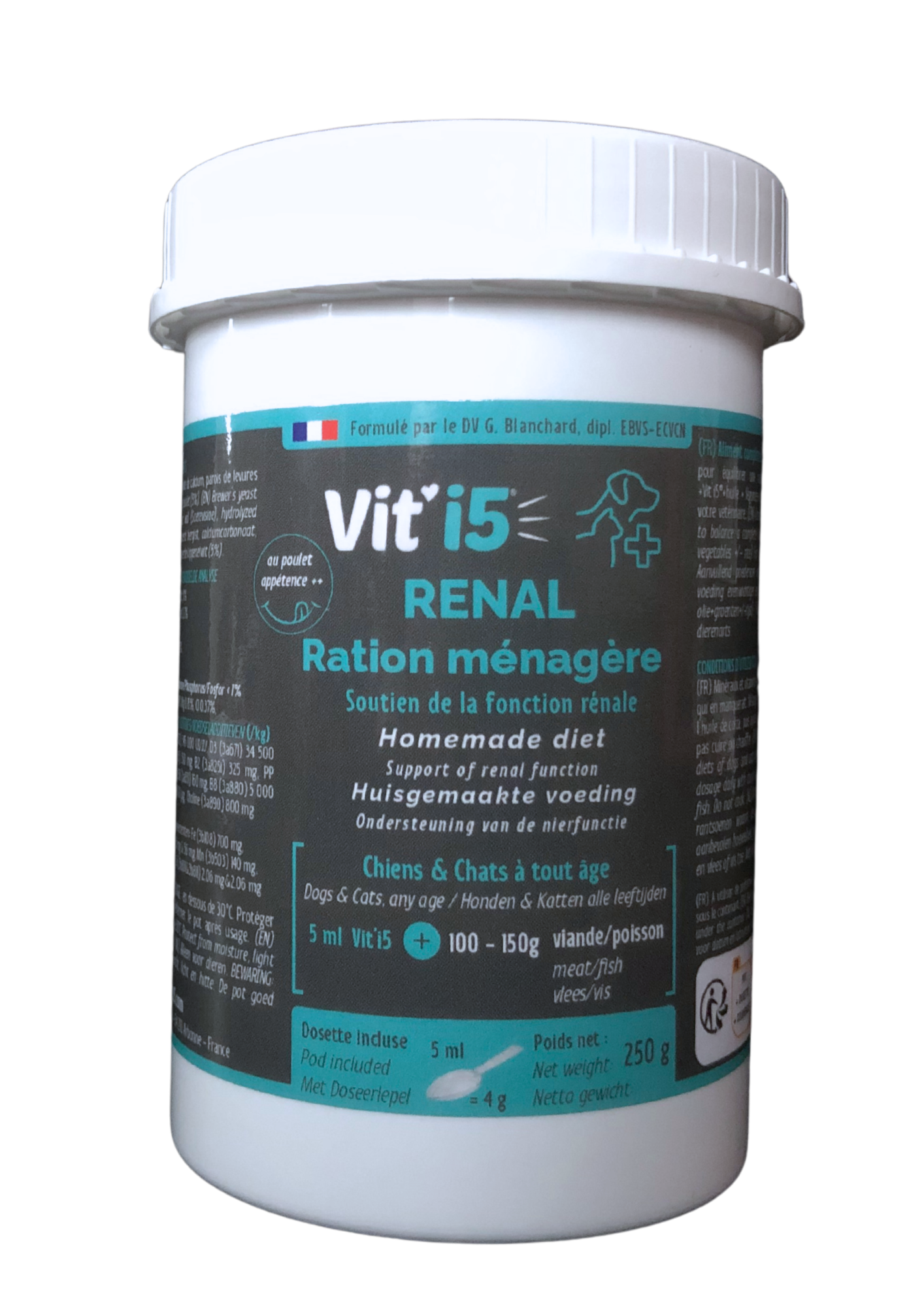 |
Vit’i5 Renal ration ménagèreAvailable in powder : 250gMineral & vitamin powder feed for dogs and cats to balance a homemade diet (meat or fish + Vit’i5®™ + oil + vegetables +/- rice) for dogs and dats with chronic renal failure
|
Why a food supplement with a homemade ou mixed diet ?
Why a food supplement?
A total or partial homemade diet (or the simple intake of meat in addition to kibble or can) needs to be balanced, because without the intake of calcium (sometimes phosphorus), vitamins and trace elements, this dog and cat diet is very deficient.
What's the problem?
There is no calcium (or very little) in meat, but there is phosphorus. However, for the body to remain healthy, more calcium than phosphorus is needed in the diet, always. Calcium (and sometimes phosphorus) must therefore be added to the ration. A homemade diet also lacks other micronutrients (vitamins, trace elements) that are essential for the good health of dogs and cats, even if the ingredients are of very good quality.
Why did Dr Vet G. Blanchard conceive Vit'i5 ?
Why mineral supplements in a homemade diet ?
[...] Vit'i5 provides almost half of the nutritional needs. These are micronutrients (calcium, possibly phosphorus, 12 vitamins, 6 trace elements), so very small quantities, but still absolutely essential to keep dogs and cats healthy. [...]
Interview with Dr. Géraldine Blanchard on Vit'i5 supplements
Why did you formulate a specific range, Vit'i5, of mineral supplements? There were already some available...
The Vit'i5 range of mineral and vitamin supplements is formulated specifically to balance the intake of meat or fish in the diet of domestic carnivores (dogs, cats, ferrets). When the ration is domestic, Vit'i5 is an ingredient, in the same way as meat, oil, vegetables. When the ration is composed of kibble or box (complete food) and meat or fish, Vit'i5 allows you to balance the meat and fish because complete food does not compensate for this unbalanced intake. It is therefore a question of providing what the major ingredients do not provide: minerals, trace elements, vitamins. Mineral and vitamin supplements already existed, but were not suitable given current scientific knowledge.
Read the whole article
What are the risks if I don't give Vit'i5 ?
Giving a ration with meat, vegetables, rice, and even rapeseed oil inevitably leads to deficiencies and diseases (which we don't always see very quickly). It's not a good idea. It is really important to understand that Vit'i5 or an equivalent is as important as meat for long-term health.
They take more or less time to be visible. But the deficiencies that set in have the following consequences:
* kidney failure due to secondary hyperparathyroidism with calcium deficiency (even if you give dairy every day!),
* urinary crystals (calcium oxalate or struvite depending on the case, and the composition of the ration), which can give rise to urinary stones
* loosening of the teeth (the gums are not strong enough due to lack of calcium and vitamin D), which creates inflammation and infections of the gums because microbes pass between the teeth and gums
* hair and skin in poor condition, less supple skin, and less good digestion, due to deficiencies in copper and zinc and vitamin A, which cause poor activity of the enzymes of protein synthesis, digestive secretions, musculature and collagen
* lack of tone, drive, nervous and cerebral capacity due to deficiencies in B vitamins, which are the small muscular arms of the entire energy metabolism
If it is a growing puppy or kitten, it is worse and happens even faster, because growth requires a better diet than that of the adult.
If it is a pregnant and lactating female, it is also very serious for the mother. Uterine atonia is often observed, which often requires a caesarean section, difficulty in several lactations, and a lack of immunity with diseases that are more common in breeding, such as intestinal parasitism, giardiasis, etc. but also in puppies.
Giving a bite of meat to get the puppy or kitten used to solid food is not a problem. Giving meat in quantity, even if there is also access to kibble, is another story: the protein intake of meat is a good idea, to be balanced, because meat also provides phosphorus but no calcium, and for the calories it brings, it does not provide vitamins...
Hence the interest of Vit'i5 in this case, at the right dose (mix Vit'i5 and plain yogurt, then add the meat, this will make a good first solid food to prepare for weaning)
Vit'i5 composition
Question about the yeast in Vit'i5
Do vitamins only come from yeast in Vit'i5 ?
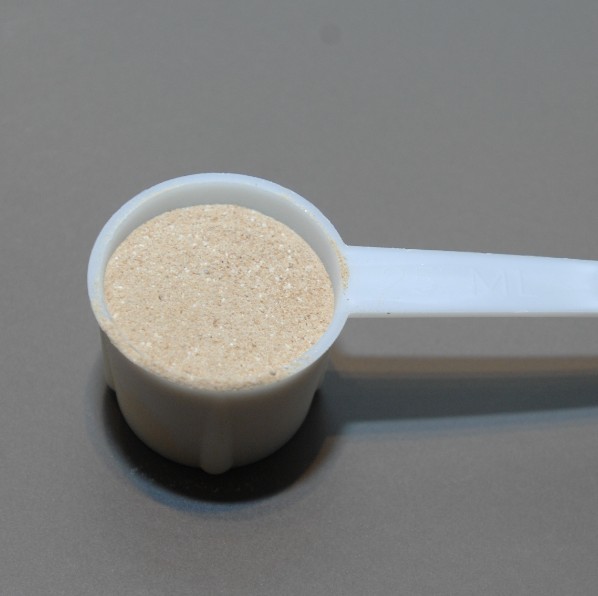 No, vitamins displayed in the product label are added, the brewer's yeast is only a natural basis which also appears to be palatable. Brewer's yeast contains vitamin B, besides thoses written in the product label (but no vitamin B exces is possible).
Question about Color or Smell
Color or odor slightly changed since last time I bought the same product
There are no flavour nor coloring added to Vit'i5. Besides minerals, vitamins and trace elements, there is only brewer's yeast added. Yeast is generally appreciated by cats and dogs.
Despite our efforts, it is really difficult to have a constant and identical brewer's yeast (it remains a natural product) and it can have a slightly different odor or color for each manufacturing batch.
Question about taurine
Does the taurine contained in Vit'i5 induce a risk for my dog ?
No, the dog is able to synthesize it naturally and absorbs it when consuming meat (dose depending to the cooking). There is no risk of overdose.
The reported risk for humans is linked to the absorption of energy drinks and comes mainly from caffeine, which is also problematic in dogs and cats.
On the samed topic, read Géraldine Blanchard article about taurine and caféine (in French) :
What is taurine ?
What sources of calcium and phosphorus? why add any ?
Calcium is calcium carbonate, phosphorus is dicalcium phosphate
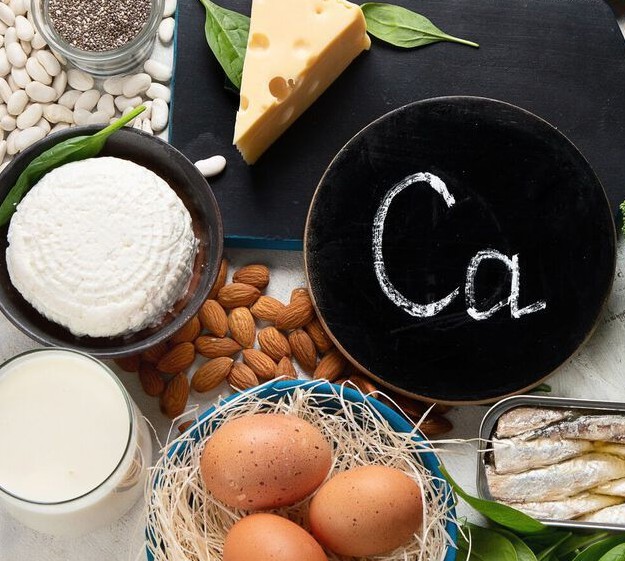 ....a salt which does not increase the postprandial production of parathyroid hormone as sodium or potassium salts do ...
We add the two, in Ca / P ratio = 3 to cover the needs without excess, and keep the final household ration a Ca / P ratio between 1 and 2, since the other components of the diet (meat, oil, vegetables, starches) provide phosphorus (enough for an older dog or cat, but not enough for a younger one or during reproduction) and hardly any calcium.
To be read on the same topic, Dr Vet Géraldine Blanchard's articles on nutritional requirements for cats and dogs
Calcium and Phosphorus
Cat's calcium requirement
Dog's calcium requirement
How much yogurt or cheese to cover a dog's need in calcium ?
Vit'i5 distribution
Question about Vit'i5 acceptance
My pet is not eating well his home made diet BUT not when I add the powder...
- The way to intoduce Vit'i5 is major: when used to a taste, the do or cat can be reluctant to a change, so adding Vit'i5 may be better to be proressive. Start small, and increase the amount to the daily recommendation day after day
- The preparation of the diet is also very important: first mix canola oil and Vit'i5, then add the vegetables, mix well, then the meat or fish, mix well, then the starch cooked the same day and mix well . The mixture is generally well accepted.
Avoid the additttion of the powder on top of a plate of food, to avoid a "high tasty spot" o a "powdery spot" that could induce aversion if smelt directly.
- As for any new ingredient, it is advised to put Vit'i5 progressively in the diet : begin with a small amount mixed in the daily diet, until it has been accepted by your pet and then increase a little the given dose. Step by step the goal is to finally give the entire dose of Vit'i5 needed.
- To minimize the smell of brewer's yeast, you can also:
- keep the jar in the fridge
- add a few drops of soy or viandox sauce or broth to the mix Oil+Vit'i5, or mix in plain yogurt
- warm the meat before mixing to enhance its smell
On the same topic, read Géraldine Blanchard article on her blog (in French) :
How to get Vit'i5 accepted by a cat who eats only meat and vegetables ...
Our blog's articles about Vit'i5
Find other articles on Dr Vét Géraldine Blanchard's blog about Vit'i5 use in a homemade diet (in French)
Why Vit'i5 in a homemade diet ?
Is Vit’i5 useful if I already give kibble and meat ?
Can a mix containing some Vit'i5 be frozen?
How to prepare a homemade diet for a dog or a cat
Example of a homemade diet recipe with Vit'i5

Questions about homemade diet ?
Check our page of frequently asked questions about homemade diet: the choice of food type, the signs of a healthy diet.

Questions about the recipes ?
Check our frequently asked questions page on the recipes available on cuisine-a-crocs: the type of recipe you can order, the ingredients ...